
|
Getting your Trinity Audio player ready... |
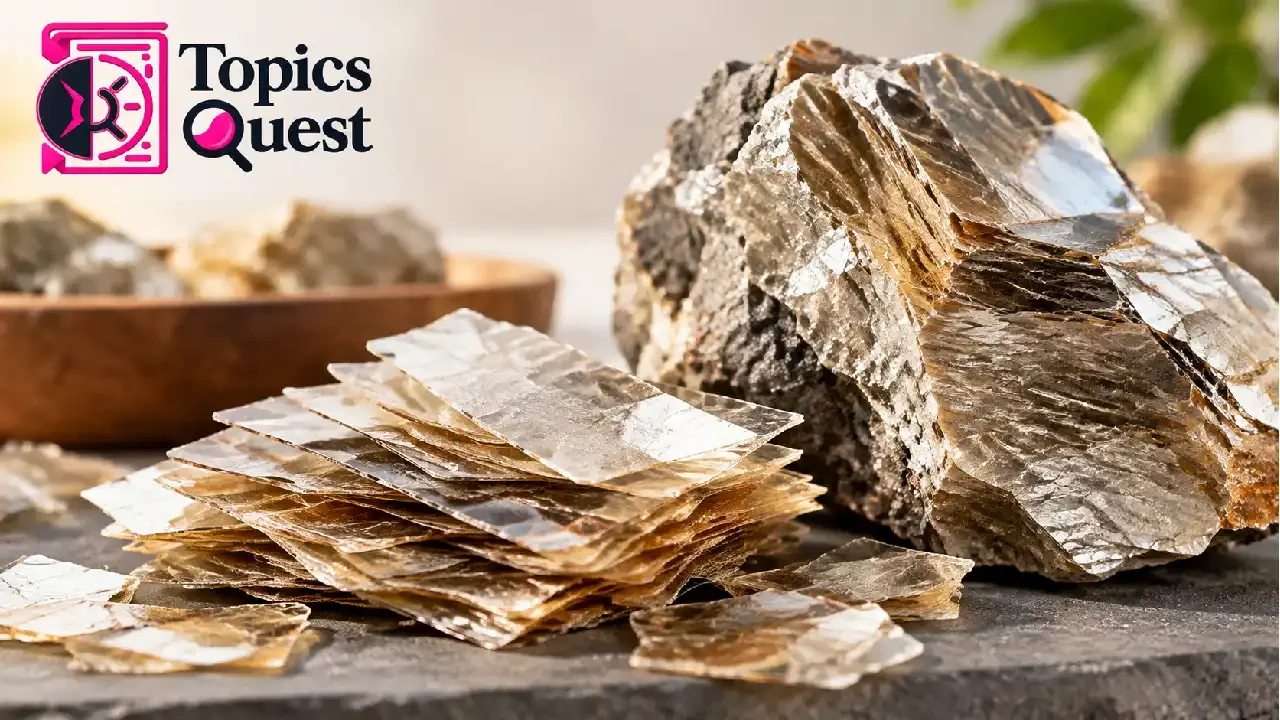
For those asking exactly what is mica, it is a broad group of 34 naturally occurring silicate minerals characterized by their remarkable ability to split into nearly perfectly flat, transparent sheets. This unique physical property, combined with exceptional heat resistance and electrical insulation capabilities, makes the mineral indispensable across global industries, from cosmetics to high-voltage electric vehicle manufacturing.
Because of its glittering surface…” with: “Because of its glittering surface and durable structure, mica schist is sometimes used as decorative building stone, architectural cladding, and landscaping materials
Defining exactly what is mica mineral classification involves looking deep into Earth science. The term originates from the Latin word micare, which translates to “glitter” or “shine,” accurately reflecting the brilliant, reflective nature of the material. Geologically, mica is a group of minerals, rather than a single distinct stone. This group of sheet silicate materials shares a remarkably similar internal atomic arrangement, allowing them to form into flat, continuous structures. Understanding what is the mica mineral group requires recognizing that these variations feature slight chemical differences, which ultimately dictate their specific commercial and industrial applications.
For researchers exploring mica what is it fundamentally, these minerals are hydrous potassium aluminum silicates. They often contain additional elements such as magnesium, iron, and lithium. The presence or absence of these trace elements creates the different colors, thermal thresholds, and optical qualities associated with the distinct variations found within the mica group.
Geological Formation and Origins
The Earth science community studies this naturally occurring mineral extensively because its formation provides profound insights into the planet’s tectonic and geothermal history. It forms in a variety of geological environments, primarily within igneous rocks and metamorphic rocks, and occasionally appears as detrital flakes in sedimentary formations.
In igneous environments, the mineral crystallizes directly from cooling magma deep within the Earth’s crust. It is particularly prominent in granites and pegmatites. Pegmatites are exceptionally coarse-grained igneous rocks that cool very slowly over extensive periods, allowing massive individual crystals—often referred to as “books”—to form. These large crystalline books can sometimes span several feet across, yielding the massive sheets of mica that are highly prized for industrial manufacturing and historical window glazing.
In metamorphic environments, the mineral forms through the intense heat and pressure applied to pre-existing rocks during tectonic shifts. When shale or mudstone undergoes significant tectonic stress, the clay minerals within them recrystallize into much larger, distinct flakes. This transformative process frequently results in a highly foliated rock formation known as schist.
The Formation of Mica Schist
When examining what is mica schist, geologists define it as a medium-grade to coarse-grained metamorphic rock characterized by its high concentration of aligned reflective crystals. During regional metamorphism, such as when continental plates collide, immense pressure forces the growing crystals to align perpendicular to the direction of the applied pressure. This alignment creates a heavily foliated, layered texture that is the defining hallmark of a schist formation.
Mica schist is highly durable and possesses excellent heat resistance. Because of its glittering surface and long-term structural integrity, it is frequently used as a premium building stone, decorative architectural cladding, and resilient landscaping material.
| Schist Component | Chemical Formula | Structural Contribution |
| Muscovite / Biotite | Variable based on type | Provides the reflective, foliated texture and heat resistance. |
| Quartz | SiO₂ | Adds overall hardness and geological durability. |
| Feldspar | Variable aluminosilicates | Contributes to the structural strength of the rock matrix. |
| Garnet / Staurolite | Complex silicates | Acts as common accessory minerals identifying the metamorphic grade. |
The chemical composition of a schist formation depends heavily on the proportion of these minerals. The geochemical evaluation of these formations often reveals that the schists were generated from the metamorphism of shale, providing a clear window into ancient continental collisions, such as the formation of Pangaea over 275 million years ago.
Chemical Composition and Crystal Structure
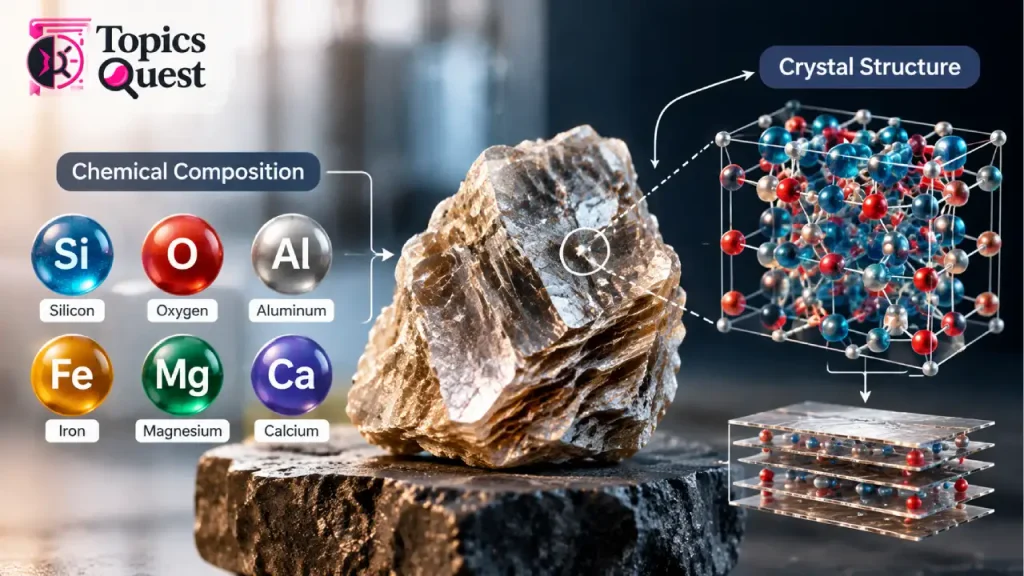
To fully answer what is mica made of, one must look at the material at the atomic level. All phyllosilicate minerals possess a highly specific molecular architecture consisting of continuous two-dimensional sheets. The arrangement of the atom dictates every physical property the material exhibits, from its flexibility to its thermal conductance and resistance.
The TOT Layer Architecture
The fundamental building block of the crystal structure is the TOT layer. This configuration consists of one central octahedral sheet (O) sandwiched between two identical tetrahedral sheets (T).
The tetrahedral sheets are composed primarily of silicon and oxygen atoms forming repeating tetrahedrons. In certain variations, an aluminium atom replaces a silicon atom in this framework, altering the mineral’s charge. The central octahedral layer typically contains aluminium, iron, or magnesium atoms surrounded by oxygen and hydroxyl (OH) or fluorine groups.
Because the combined TOT layers carry a residual negative charge, positively charged interlayer cations—most commonly potassium (K+)—sit between the TOT layers to balance the molecule.
Perfect Cleavage and the Monoclinic Crystal System
The potassium bonds holding these TOT layers together are relatively weak compared to the extraordinarily strong covalent bonds within the sheets themselves. This specific atomic arrangement results in the mineral’s most famous physical trait: perfect cleavage.
Because of this perfect basal cleavage, specialized equipment can peel the mineral into exceptionally thin layers, sometimes reaching just one nanometer in thickness. These thin sheets remain incredibly strong, flexible, and elastic, maintaining their structural integrity even when isolated. Crystallographically, the mineral belongs to the monoclinic crystal system. However, the arrangement of atoms within the sheets often gives the bulk crystals a distinct pseudo-hexagonal appearance. When observing a raw, unrefined crystal, this hexagonal geometry is frequently visible to the naked eye.
Visual Characteristics and Optical Properties
For those wondering what does mica look like, the answer depends entirely on the specific chemical composition of the geological sample. Generally, the mineral appears as shiny, flat, sheet-like plates or tiny glittering flakes embedded tightly in a host rock (geology) matrix.
In its natural bulk form, a thick book of the mineral may appear opaque, dark, and heavy. However, when it is split into exceptionally thin sheets, the material becomes highly translucent or completely transparent. The surface exhibits a brilliant, pearlescent, or vitreous luster that reflects light uniformly. Due to its naturally reflective nature, properly ground cosmetic grade powder imparts a striking sparkle and shimmer to anything it touches, making it highly desirable in visual and decorative applications.
The Primary Types of Mica
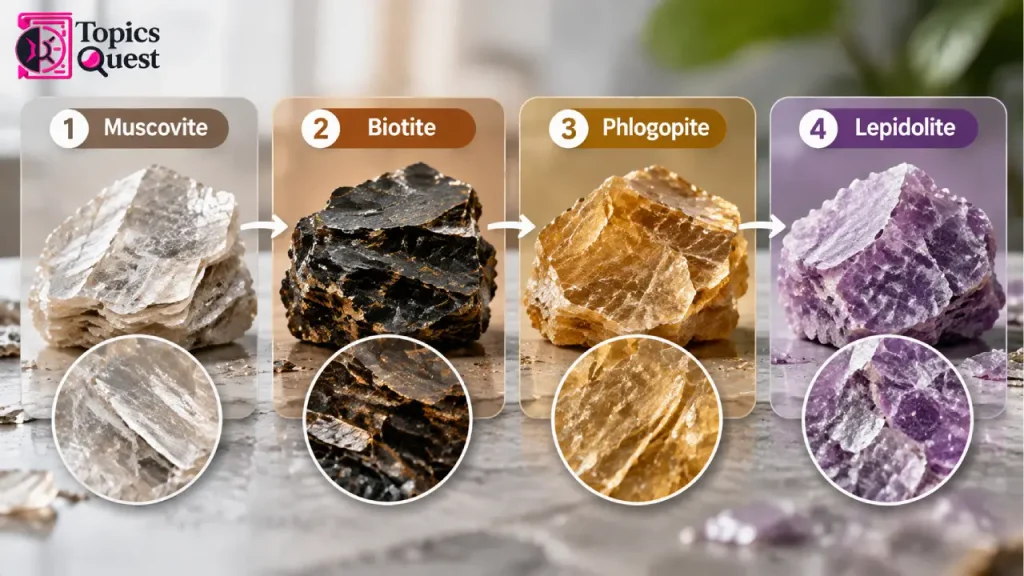
While the group of silicate minerals contains 34 distinct members, commercial and industrial manufacturing primarily rely on a select few. Understanding the differences between these variations helps clarify what is mica and what is it used for in highly specialized scientific and industrial fields.
Muscovite (White Mica)
So, what is muscovite exactly? Muscovite is the most abundant and common variety found globally. It is a highly stable hydrous potassium aluminum silicate mineral with the ideal chemical formula KAl₂(AlSi₃O₁₀)(OH)₂.
When identifying samples, what does muscovite look like? It is generally colorless, transparent, or silvery-white when expertly split into thin layers. Because of its brilliant clarity, it is frequently referred to as “white mica.” Historically, before modern glass manufacturing, large sheets of transparent muscovite were used extensively as window panes in Russia, earning it the enduring historical nickname “Muscovy glass.” These window sheets were highly valued for their ability to withstand extreme thermal changes in early stoves and lanterns.
Specifically, what is muscovite used for in manufacturing? The answer revolves around its exceptional electrical resistance. Muscovite mica possesses tremendous dielectric strength, making it a premier insulator (electricity). It is highly valued in the manufacturing of complex capacitors, advanced electronic equipment, and thermal safety barriers. To define what is a muscovite specimen structurally, it is a dioctahedral mineral that safely withstands continuous temperatures up to 500°C to 600°C before experiencing any meaningful thermal degradation.
Phlogopite (Amber Mica)
Phlogopite is a potassium magnesium aluminum silicate hydroxide. It is easily distinguished by its yellowish-brown, rich amber, or bronze coloration.
Phlogopite mica is highly prized for its extraordinary heat resistance. While muscovite is excellent for standard high-voltage applications, phlogopite remains structurally stable at much higher temperatures, safely withstanding sustained exposure to 900°C to 1,000°C. For this reason, heavy industries utilize muscovite and phlogopite for distinctly different thermal thresholds. Phlogopite is the preferred, uncompromising material for high-temperature industrial furnace insulation, aerospace engine components, and automotive exhaust heat shields.
Biotite (Black Mica)
When classifying darker minerals, what is biotite mica? Biotite is a potassium iron magnesium aluminum silicate. Because of its substantial iron content, it typically appears dark green, deep brown, or completely black.
While less commonly utilized in commercial electronics due to its iron content—which measurably lowers its insulating capabilities—biotite remains an incredibly important mineral for geological dating and scientific research. It is abundantly found in granite and other igneous formations, providing geologists with key data regarding the age and cooling history of the surrounding rock formations.
Synthetic Fluorophlogopite
In addition to the naturally occurring forms, modern materials science has developed highly advanced synthetic alternatives. Synthetic mica, known formally as synthetic fluorophlogopite (KMg₃AlSi₃O₁₀F₂), is meticulously manufactured in a laboratory environment by melting specific raw materials at extremely high temperatures.
Synthetic mica offers several distinct structural advantages over natural mica:
- Superior Thermal Stability: Synthetic fluorophlogopite can withstand temperatures up to 1,100°C, safely surpassing even premium natural phlogopite.
- Exceptional Chemical Purity: Because it is created in a highly controlled environment, it contains virtually no heavy metal impurities, making it highly desirable for sensitive cosmetic formulations.
- Brilliant Optical Clarity: The complete lack of natural geological impurities results in a brighter, more vibrant sparkle when used as a specialized pigment.
- Consistent Dielectric Properties: The flawless uniformity of the synthetic crystals provides absolute capacitance stability for the most advanced aerospace and defense electronics.
Physical Properties and Electrical Insulation Mechanics
To fully grasp mica what is it used for, one must deeply appreciate its unique combination of physical, chemical, and electrical properties. Few materials on Earth offer the same uncompromising versatility in extreme environments.
Dielectric Strength and Electrical Insulation
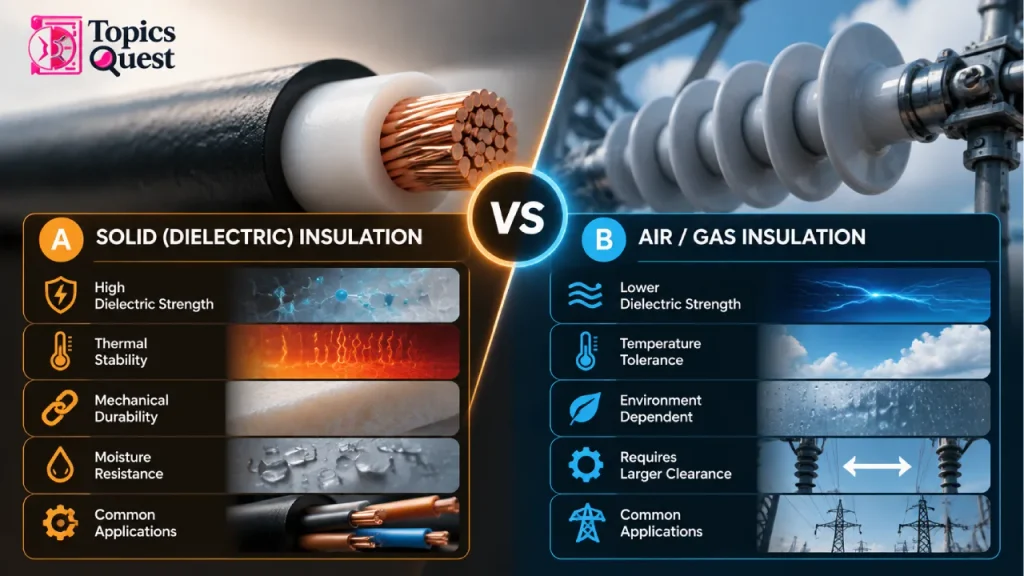
Mica is an elite dielectric material. It successfully resists the flow of electricity and can withstand exceptionally high voltage without suffering a catastrophic dielectric breakdown. In electrical engineering, dielectric strength is measured by the maximum voltage a material can withstand before its insulating properties fail. Mica routinely exhibits a dielectric strength of 15 to 30 kV/mm, vastly outperforming many modern synthetic polymers and maintaining its integrity under immense stress.
| Material Type | Dielectric Strength (Volts per mil) | Max Continuous Temperature | Water Absorption |
| Muscovite Mica | ~2000 | 500°C – 600°C | < 1% |
| Phlogopite Mica | ~1500 | 900°C – 1000°C | < 1% |
| Kapton (Polyimide) | ~3000 | 400°C | ~ 4% |
| Nomex 410 | ~900 | 220°C | > 1% |
As demonstrated in comparative testing, while advanced polymers like Kapton offer high dielectric strength, they cannot match the extreme thermal ceilings or the low water absorption rates of inorganic mineral insulation.
Suppressing Corona Discharge
Furthermore, the material naturally suppresses corona discharge. In high voltage systems, localized electrical fields often ionize the surrounding air to create a corona discharge, making specialized insulators like mica the preferred choice for maintaining long-term structural integrity over standard organic polymers. . Mica, being a robust inorganic stone, is highly resistant to this continuous ionization damage, ensuring the long-term reliability of the electrical insulation in critical infrastructure.
Thermal Conductance and Chemical Inertness
The material exhibits highly specialized thermal conductance and resistance properties. It is intensely resistant to the transfer of heat across its cleavage planes, making it an excellent thermal barrier. Concurrently, it remains entirely non-combustible and will not emit toxic, halogenated fumes when exposed to open flames. This makes it an ideal, uncompromising material for fireproofing and thermal shielding in passenger transit.
As a highly stable natural mineral, it does not react with water, oil, standard industrial solvents, or most acids. This chemical inertness ensures that engineered mica products maintain their structural integrity even in the harshest, most corrosive industrial environments.
Industrial and Commercial Applications
The vast uses of mica span across nearly every sector of the modern global economy. If you wonder what is mica used for, you will find it integrated into systems and products utilized daily.
The Electrical Industry and Electric Vehicles
The electrical industry represents the largest global consumer of high-quality sheet mica. Because the mineral is a superior insulator, it is used extensively to protect and isolate components that manage powerful electrical currents.
- Capacitors: The material’s incredible capacitance stability makes it ideal for manufacturing reliable capacitors used in radio frequency equipment, aerospace electronics, and high-end audio devices.
- Electric Vehicles (EVs): As the automotive industry transitions to electric power, phlogopite tapes are meticulously wrapped around the copper windings inside EV traction motors. This vital insulation prevents catastrophic short circuits, manages intense operational heat, and stops corona discharge. Advanced EV battery packs also incorporate multiple meters of phlogopite tape per kilowatt-hour to manage thermal runaway safety.
- Electronic Equipment: From simple household appliances like toasters and hair dryers to complex telecommunications infrastructure, electronic equipment relies on precision-cut mineral separators to function safely.
Construction, Paints, and Plastics
A massive volume of mica used globally goes directly into the construction industry. The primary commercial use of dry-ground mica flakes is in gypsum wallboard (drywall) joint compound. The smooth, flat flake acts as a reinforcing filler, improving the workability of the compound and preventing it from cracking as it cures.
Additionally, the roofing industry heavily utilizes the material in asphalt roofing shingles. The mineral particles are sprinkled onto the surface of the shingles to act as an anti-stick coating, preventing the rolled asphalt from sticking to itself during transport and installation. The material also provides excellent weather and ultraviolet radiation resistance.
In the manufacturing of plastics and natural rubber products, the ground mineral acts as a reinforcing filler and a highly effective mold-release agent. It measurably improves the dimensional stability and stiffness of plastic parts used in automotive engineering, while also absorbing sound and mechanical vibration. It also serves as a highly effective pigment extender in automotive paints, where its flat, platy structure helps orient color pigments perfectly, creating deep, pearlescent finishes.
Cosmetics and Personal Care Formulations
When consumers ask mica what is it used for in daily life, the beauty industry is often their first point of discovery. Cosmetic grade mica powder is a staple, foundational ingredient in modern makeup, skincare, and personal care products.
Because of its natural optical qualities, the ground mineral provides the brilliant shimmer and sparkle found in eyeshadows, highlighters, lipsticks, and nail polishes. The mineral is carefully milled into a fine, smooth powder that reflects light flawlessly to hide skin blemishes and provide a radiant glow. Today, many prestigious cosmetic brands utilize highly purified natural material or synthetic fluorophlogopite to ensure the safest, most vibrant visual effects while addressing supply chain purity.
Advanced Scientific and Technical Grade Uses
Technical grade variations find utility in highly specialized, precision fields.
- Atomic Force Microscopy: Because the material can be expertly cleaved to reveal a pristine, atomically flat surface, it is the premier substrate used in atomic force microscopy (AFM). Scientists rely on this flawless basal plane to observe DNA molecules, lipid bilayers, and complex proteins at the nanometer scale.
- Optical Equipment: The mineral is remarkably transparent to radiation and specific wavelengths of light. It is utilized to create specialized optical filters, precise wave plates, and lenses for high-end scientific instruments.
- Safety Equipment: High-clarity window sheets made of the highest grade muscovite are used in industrial blast furnaces, high-pressure steam boilers, and oxygen-breathing equipment because the material will not melt or shatter under extreme heat and pressure differentials.
Ethical Sourcing and Global Mica Mining
Understanding the full scope of mica mining is essential for modern industries committed to sustainability. Historically, the mineral has been extracted for thousands of years, with the Mayans using it to decorate temples and indigenous North Americans using it in burial mounds. Today, large-scale mining operations exist in countries like China, the United States, and Brazil.
However, a significant portion of the world’s natural sheet extraction originates from India and Madagascar. In certain regions, specifically the Jharkhand and Koderma districts of India, the supply chain is actively transitioning from historically informal, artisanal extraction methods toward highly regulated and structured mining practices. To ensure a sustainable, safe, and fair future for the industry, global coalitions have been established.

The Responsible Mica Initiative (RMI) actively brings together manufacturers, cosmetic brands, and local governments to establish highly regulated, ethical mining practices. These proactive initiatives focus on eradicating child labor, improving workplace safety, and empowering local communities by ensuring fair wages and building robust social programs. Through transparent sourcing guidelines and the continued development of synthetic alternatives, the industry continues to provide this vital resource while working constructively to improve global labor standards and community well-being.